Saturday, May 18, 2019

Plymouth Lawn Yeti Predicts Bruins Stanley Cup Victory


Shortly after the Boston Bruins eliminated the Carolina Whalers Hurricanes to advance to the Stanley Cup finals, we sought out the sage advice of Plymouth's favorite Lawn Yeti.

The Lawn Yeti holds court daily on the regular, just off Long Pond Road around where Plymouth starts looking a lot like Cape Cod.

He's an avid hockey fan, going back to the days when Eddie Shore patrolled the blue line. We showed up with a bottle, and got his thoughts on the remainder of the NHL season.

Please note that one does not interview a Lawn Yeti, especially if he is drinking whiskey. One just introduces topics, and the Lawn Yeti handles the rest. We should note that the Lawn Yeti is very parochial.

*******************

Stacey: How did you like the game tonight?

Lawn Yeti: It was a wonderful game. We beat them like they stole something while concurrently talking about our mothers.

I don't feel badly about the sweep, either. That's a stolen hockey team! They should still be the Hartford Whalers.

Gordie Howe finished his career playing for the Whalers. Imagine if they tried to haul Gordie Howe down to Carolina?

Stacey: He might have melted.

Lawn Yeti: I'd hate to be the guy who had to sell Mr. Hockey on a move to the Confederacy. His jaw might still be broken.

Stacey: Gordie broke jaws for a lot less than "Surprise! You're moving to Raleigh!"

Lawn Yeti: Carolina's history is slavery, slavery, slavery, secede from America, KKK, nothing, nothing, invents planes, nothing, nothing, basketball, nothing.

Stacey: Tough to respect that, huh?

Lawn Yeti: F**k Carolina. Treasonous, Mayberry livin' scoundrels. I could watch them all be skinned. We should have sawed them off of the continent in 1865.

Stacey: I agree. The very Loser Tears they cry are the sustenance of the Gallery Gods. How do you see the West working out?

Lawn Yeti: Whoever wins the West is just the next clown out of the car in the Boston Sports Jihad. The Red Sox win the World Series, the Patriots win the Super Bowl and the Bruins take the Stanley Cup.

Stacey: The Celtics lost.

Lawn Yeti: Sometimes, you have to lose a battle to win a war. If the Celtics won this year, they would get complacent. Now, they'll stop at nothing to get that Anthony Davis kid, you know, the one with the big eyebrow. Him and Uncle Drew might win 8 to 10 titles, instead of the 1 or 3 you would win with the current cast of characters.

The concept of Winning By Losing is difficult to understand for almost everyone but bankruptcy lawyers and mixed wrestling fetishists, but it is the silver lining to the Celtic storm cloud.


LY: Who is even in the West finals?

Stacey: The St. Louis Blues and the San Jose Sharks.

LY: Jesus H. Chrysler! The road to the Stanley Cup should not run through North Carolina, Missouri and California.

Stacey: It's like that old Letterman joke. "When someone says Texas, you immediately think Ice Hockey."

LY: Back when I was a Bay Bay Yeti, the Cup was fought for in places like Toronto, Detroit and Montreal. How and Why do they even play hockey in Texas? It's like being the best surfer in Iowa.

Stacey: Brad Park used to not tell the story about the time he didn't conduct hockey clinics in Texas.

LY: I heard about that. As soon as all the kids had sticks, they elected a colonel and went out into the street to beat Mexicans.

Stacey: The Sharks and the Blues are 1-1 in a best of 7 as we talk, while the Bruins will be well-rested when the Cup begins. Is rust a concern?

LY: Canadians don't get rusty. It's too cold. They freeze, which is actually a preferred state in ice hockey. This scheduling flaw allows the players to relax and do Canada stuff... drink Molsons, talk about snow, knit sweaters, club seals.

Stacey: I think Rask is a Finn, and Chara is Slovakian.

LY: Same thing. Anthropologists will tell you that there are 4 kinds of white people. Russians, Scandinavians, Canadians (Upper and Lower, a grouping that includes the northern United States) and a 4th group comprised of various non hockey-playing nations like England, Germany, France and Australia.

Stacey: That actually explains a lot of World History.

LY: That's why I get the big bucks, shorty.

Stacey: Who wins the Stanley Cup?

LY: Boston. They lose the first game, then win 4 of the next 5.

Stacey: Stanley Cup MVP?

LY: The NHL doesn't have an MVP for the playoffs. They instead award a Conn Smythe trophy. Rask will win it.

Stacey: Just checking.


Tuesday, May 14, 2019

The Battle Of Wareham

On June 13-14th, 1814, war came to the South Coast...
Coastal towns in colonial/post-colonial America tended to be centers of piracy, which we called privateering back then. As near as I can tell, the difference is that a privateer has a letter from the Queen or the President, while the pirate is in business for himself.

It was a pretty good deal. You could get a letter of marque from the government and go hunting for British shipping. 300 British ships were seized in the Revolution, and I'll get the 1812 number later (251 registered privateers, they got 1500 British ships). Them's righteous bucks, real J-Lo style booty.
New England represented hard back in the pirate days, for several reasons. New England is home to numerous ports, harbors, coves, lonely beaches, sneaky little islands, hidden inlets and course-dictating currents. All of these aid the piracy effort. The coastlines of New England in general and Cape Cod in particular are nothing but all of the above. Wareham is even worse.
We're also a nautical people- you tend to not notice it while you're living here, but if you go inland a bit, you realize how unusual it is in America to have been on a boat that has, say, pulled up a lobster trap.

We still depend on the sea now, but we REALLY depended upon it back then. New Englanders sailed instinctively, rowed like a motherlover (when fleeing New York, George Washington made sure that Massachusetts guys were doing the rowing), and more than one of our Captains sailed rings around more than one of their Admirals. I should add that, for some reason I have no theory on, our coastal people sail better than, say, Carolina's coastal people.
Finally, we're centrally located. If New York City is a mall and London is a very nice trophy home, Cape Cod is the nasty neighborhood you have to carry your goods home through. There are a hundred places to attack from around here, and a million places to escape to afterwards. Cape Codders are not afraid of a little dirty money now and then, even if we have to cut the government in on it.
The Brits were doing it to us, too, so it's not as Somali as it sounds. Even if it is, Cape Cod fattened itself quite nicely on British shipping during the times of trouble. It was all good until John Bull came to town to get some payback.
The British became aware of a ship with a letter of marquee being present at Wareham. Wareham had dodged trouble in the Revolution, but she had a fine privateering history. The sloop Hancock came from Wareham, Capt. John Kendrick of Wareham was the boss on the Fanny and the Count d'Estaigne and Capt. David Nye was the Head Sailor In Charge aboard the Sea Flower.
The squadron centered around HMS Superb off of New London dispatched HMS Nimrod with several smaller ships to burn the pirate ships... and perhaps the town around them. Nimrod was a frequent foe of American privateers operating off Cape Cod, and had bombarded Falmouth the December before.
On June 13th, Nimrod came within sight of Fort Phoenix in Fairhaven. Residents of New Bedford and Fairhaven began to flee to the countryside as the militia began to gather. This may have been a feint meant to send militia to the wrong place.  A sizable militia gathered and Fort Phoenix let off some shots (more to summon militia than to sink Nimrod), but the British moved past it. Militia headed to Mattapoisett as well, but the British kept heading up Buzzards Bay to Wareham.
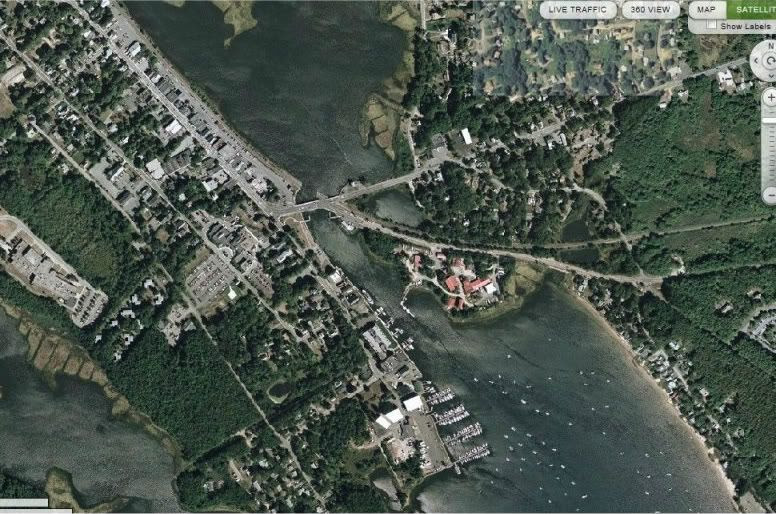
The Nimrod then dispatched barges carrying 225 soldiers up the Wareham River, and they landed where the Narrows Bridge (pictured above) is now, near Tobey Hospital. Risking gunfire from both sides of the river, they came ashore and invaded Wareham.
They sent sentries to inhabit the high ground, and then fired a Cosgreve rocket (a British incendiary weapon, known for it's songworthy Red Glare) into a cotton factory that had been built by a consortium of 60 Boston businesses. The locals managed to put the fire out, but much damage was done.
The Brits took a Captain Bumpus (who may have been the Bumpas kidnapped from Westport, most likely set up by the spy who relayed the news of a privateer at Wareham) to his home, where they destroyed/confiscated military supplies.
A party of Wareham man arrived to see how we could get out of this, and the Brits said they were here to find men and ships related to privateering, and that they would not fire on inhabitants or destroy private property. They were very interested in ships belonging to Falmouth, which they had attacked 6 months before.
We lost a lot of good boats that day. The Fair Trader, 44 tons and able to hold 18 guns, was burned down to the hull. The brig Independent suffered the same fate at 300 tons. She was in the stocks, ready to launch. We also lost brand new schooners Fancy, Elizabeth, and Nancy. All told, a total of four schooners, five sloops, a ship, a brig, and a brig-under-assembly at William Fearing's shipyard were put to flame.
Wareham scrambled up what militia they could get (a dozen or so men under Issac Fearing), and marched forward to fight 225 British marines. The Brits were leaving by then, after having done $1 million (an incalcuable amount today) in damages, half of it being suffered by the cotton factory. The Brits fired more rockets into the town, which they threatened to burn upon their return.
On June 20th, two unidentified young men were sent to the Circuit Court in Boston under charges of Treason for aiding the British in their attack on Wareham.
The Nimrod then, at some disputed point, ran aground at Quick's Hole (a strait between Presque and Nashawena in the Elizabeth Islands, both islands are currently owned by the Forbes family) and had to ditch their cannon to get afloat. Nimrod survived until 1827, when she was heavily damaged off- ironically- Plymouth, England.
Wareham was down but not out, and the nation they live in eventually became so powerful as to eclipse England. Issac Fearing has a Wareham street named for him, and Brits are considerably more polite when they come here now.


Ironically, Wareham's own Geena Davis is said to have personally killed the pirate-film genre with her film Cutthroat Island. Johnny Depp eventually revived the genre, but I don't think that Geena has worked since. 

This film was notoriously bad. Matthew Modine was the male lead, and was reportedly the 10th man offered the role. Geena was married to the director, always a good thing. One character was sacked after trying to expose himself to Davis. The production company that made the film ceased to exist afterwards. "I could watch everyone in this movie be skinned," Gene Siskel once didn't say.

Despite the bombing it underwent, Cutthroat Island eventually made well over a million dollars in the UK once it went to video. One million dollars was about how much damage the British dd in 1813.

Say what you will about Geena Davis, but she took up the sword and got Wareham some reparations. That's my kind of girl. I ought to invite her to the Buzzards Bay Compound...


Surf Check: Plymouth and Bourne

A nor'easter passed us by at low tide, so we went out at high tide to see if the waves were any good.

I got held up a bit at my night job, limiting our reach geographically. This is Sagamore Beach, facing Sandwich.

Ideally, we would be further up the South Shore, at a beach like Duxbury or Scituate with higher surf.

Facing Plymouth... this was what nor'easter photographers call a PBS (Plymouth, Bourne, Sandwich) run. If we had more time, we'd have done the CEO (Chatham, Eastham, Orleans) run or the similar CHEW (Chatham, Harwich, Eastham, Wellfleet) run. The Scituate and Marshfield focus gives us the S&M run, while leaving from Bourne and starting in Duxbury upgrades it to a BDSM run. A LBQT run means Let's Bloody Quit This.

Enough with Sagamore...

...Manomet awaits!

Even weak surf looks good from up in a cliff.


Sometimes, a Surf Check article means that dangerous surf is happening. Sometimes, it's just to let you know not to worry.

This nor'easter was a bit of an anomaly. Normally, we don't get ocean storms after mid-April. A worse storm would have ruined lawn repairs up and down the coastlines of the South Shore and Cape Cod.


This storm, following 40 days and 40 nights of rain, was definitely a Freak. Much of New England got May 14th snow from this.


Monday, May 13, 2019

Fort Phoenix And The Battle Off Fairhaven


The Fort Phoenix State Reservation is a small park in Fairhaven. It is on the site of a Revolutionary War fort, and it is armed well enough to chase off Captain Jack Sparrow.

Military purposes aside, it's a lovely spot to spend a day. We did just that a few weeks ago, and it was cool enough that we're writing now to recommend it to you.

For starters, there aren't that many (there are some, especially around here) parks where the expressed purpose of said park is to Kill Englishmen.

You gotta like that!


That's a cannon-eye view of the mouth of the Acushnet River, the wet way into New Bedford. You may have been some big bad Brit admiral, but you weren't getting into New Beffuh without dealing with the hastily-mobilized toothless farmer enjoying this same view two centuries ago.

New Bedford and Fairhaven were very, very important to the colonial era economy, as well as to the colonial era military efforts. They were active ports, bringing and sending out goods that drove the local economy. They could host American warships. They were also excellent privateer bases.

Of course, stuff like that is going to attract the attention of the people you are at war with or in rebellion against. That's why little Fairhaven has a Marne-like history, with multiple military activities.


Now, in an era where you can whip out the ol' nuclear football, push a button and obliterate 500000 people on the other side of the world, a fort with a few cannons aiming out at the ocean isn't really a big deal. Strategically, Fort Phoenix is a zero.

However, it is (and was) of great Tactical value, especially back in the Day. If you have to sail what is essentially a big wooden kid's fort into the Acushnet River, a bunch of cannons aimed at you from a hill overlooking the harbor is what stereotypical Native Americans in old cartoons call Heapum Big Trouble.

Yes, you could pretty much dictate what would and wouldn't be coming in and out of New Betty by boat if you could put a few cannons on a hill over the harbor. "A cannon on a hill" is pretty much why the English fled Boston not that long after winning The Battle Of Bunker Hill.

The only way to neutralize those cannon was to hack down a forest grove, build a big floating platform for 45 cannons, sail it halfway around the world and send it headlong into direct kill-or-be-killed conflict with a bunch of whiskey-crazed English hinterland rebels. The English felt strongly enough about the Acushnet River that they took more than one crack at just that course of action.


Fort Phoenix is 1-1-1 in fights with the British, but the L was a big one.

The fort, nameless to me at least, was put up in some form before the start of the American Revolution... perhaps even to fight the French, I'm not sure. True to the hardcore nature of the South Coast, the fort was involved in several fights almost immediately.

Not a lot of people know this, or at least not a lot when compared to those who can tell you about Bunker Hill, but the first naval engagements of the American Revolution went down off of the South Coast.

The British sloop Falcon appeared off of the New England coastline shortly after the entertainment at Lexington/Concord. Both sides were scrambling to get men and supplies up to Boston for the imminent Big Squabble. The Falcon was able to bag two 'Murican ships in one day. One (the Champion) was full of supplies from Maryland intended for the rebels, and they kept that.

The other, a now-nameless sloop from Nantucket, was given a skeleton crew and some scant firearms. It was then sent to Dartmouth (Fairhaven was still Dartmouth at the time), where the Falcon had heard that a smuggler's vessel was docked. They seized that vessel, and went off to find the Falcon. They anchored off Martha's Vineyard for some reason, about 3 miles apart.


The South Coast was having none of that, and assembled a militia of 30 men carrying every gun they could get their hands on. They jammed this militia onto the whaling sloop Success, armed it with two swivel guns, and set off to kick Brit Butt.

Finding the English off of Martha's Vineyard, they immediately seized the Dartmouth ship without firing a shot. They then aimed both vessels at the British sailors on board the Nantucket ship, and closed before the Brits could flee. Shots were fired, and three Limey Poofters dropped.

The Americans then boarded the English ship. English military dudes were among the toughest on the planet. You could dunk them in Boston Harbor in April, march them on soaking foot to Lexington and Concord, and still go 1-1 against every Patriot in Massachusetts. Perhaps the only tougher people on the seas that day were South Coast whalers... especially if they had 30:11 odds.

They took the ships back to the yet-to-be-named Fort Phoenix, and the South Coast had a W in the books against the Empire On Which The Sun Never Sets.


The English had a measure of revenge in 1778. A series of operations known as Grey's Raid resulted in 4000 Brits burning New Bedford in a blaze that could be seen in Newport, Rhode Island. They then destroyed the cannon in Fairhaven before being run off by militia. The fort was rebuilt, hence the rising-from-the-ashes "Phoenix" moniker

The British took another crack at the Acushnet River during the War of 1812. The troublesome British raider HMS Nimrod made a run at New Bedford during action where they also attacked Wareham.

This story has a couple of different endings, one of which looks suspiciously like that of the Army of Two story where a pair of Scituate lighthouse keeper daughters used a fife and drum behind a dune to fool the British into thinking militia were gathering. In this one, it's a bugle or something.

Others say it was a gathering militia and fire from Fort Phoenix which made the British take a pass on tangling with New Betty. There is even a case to be made for the British feinting at Fairhaven to put the militia there, too far away to race the ships to Wareham, which was the true goal of the English visit. If that was the plan, it worked like a charm, because the British beat ?ham down like she stole something.

The burning of New Bedford's docks in 1778 was done under the orders of Sir Charles Grey. His kid, the 2nd Earl Charles Grey, is who Earl Grey's Tea is named for... something New Bedford and Fairhaven people should keep in mind when making tea purchases. Some people forget, but not Cranberry County Mother***ing Magazine.


Things were pretty peaceful since then, although the cannons are still pointing to sea.

Now, it's a nice little park on a beautiful bay, perfect for grabbing a bench and reading a book. 

There is a "Charlie Don't Surf" aspect to this park, as the Brits were misusing the area before Uncle Sam put in the basketball court and the pretty sunbathers.

A day spent watching the boats come in is a lot more enjoyable if you don't have to worry about those ships disgorging 4000 British marines to burn New Bedford. 

A distinctly American primordial urge did jump into me once or twice when I pondered using the cannon against barges and rich people boats that were sailing by, but it passed.


Sunday, May 12, 2019

Sagamore Fog

It has been a tough spring on Cape Cod, as we are in the midst of some 40 days and 40 nights stuff.

I am basically reduced to B&W photography, which is all well and good save for the fact that I have a color camera.

Grey is technically a color.

This trip to the sea was supposed to be a whale watch, but this wet weather even makes whales- who live in water, remember- miserable.


That channel marker is almost green.


Monday, April 29, 2019

Old Scituate Light

We checked out Old Scituate Lighthouse recently. We love lighthouses, and we'll get to every one in the area soon enough... 

Old Scituate Lighthouse dates back to 1811, for the low-low cost of $4000. That's a lot of $5 bills to be throwing around, especially when the guy on the $5 bill was still Thomas Jeffersoning. (Editor's note: Tommy is on the $10 bill, Stephen)


We happened to see Kareem Abdul-Jabbar there, and he was nice enough to pose in the foreground, provide some scale and make the lighthouse look bigger.

Steve, listen... if the article is called "Old Scituate Lighthouse," do try to not chop off part of the actual lighthouse (Editor's note: Steve claimed that the lighthouse moved at the last second when he shot it). It ain't that hard.


They need an Army Of One to hustle down and clean up the Army Of Two sign. The Army Of Two is probably the South Shore's best military story.

We'll do an article on it later, but the short version is that the lighthouse keeper's two daughters scared off a British raiding party in the War Of 1812. The British were coming to burn Scituate to the ground.

The girls thwarted that sh*t by hiding behind the dunes and playing a fife and drum. The British, thinking it was militia, turned tail and beat a red-coated retreat back to La Hogue.


The lighthouse is 25 feet tall and stands 71 feet above Sea Level.


She was deactivated in 1850, as Minot's Ledge Lighthouse made it redundant. Other than a brief reactivation when MLL was destroyed in a 1852 gale, it was inactive until 1994. It fell into disrepair, and only looks as good as it does now because of citizen effort. Her light still shines, as a private aid to navigation.

If you can't wait for our Army Of Two article to drop and want to research it yourself, the two sisters are known as either The Army Of Two, The American Army Of Two or The Lighthouse Army Of Two.

If The Bates Sisters aren't enough history for you, the lighthouse is also near where the USS Chesapeake and the HMS Shannon traded hands. The U lost that one, but the dying words of Captain James Lawrence- "Don't give up the ship"- became the battle cry of the US Navy.

But wait! There's more! This is also where the Etrusco ran aground in a 1956 nor'easter. The crew were rescued, and kept in various houses around town until they could get home. The ship was stuck there for several months, before being refloated, repaired and returned to service.


It tolls for thee...


Tuesday, April 23, 2019

Workers Break Stop & Shop's Corporate Greed...A Bit

Stop & Shop tried to get cheap with their labor force, which brought about a strike.

With no workers to stock the shelves and with Teamsters refusing to make deliveries, the cupboards are bare. Automated tellers can't stock the shelves... although I'm sure someone's working on that.

Automated tellers can't shop, however. Locals were loathe to support a large employer in town screwing their workers over. S&S lost $20 million a day during the strike. 

Even the Easter Bunny wouldn't cross the picket line, which may have had a role in the store caving in to the workers.