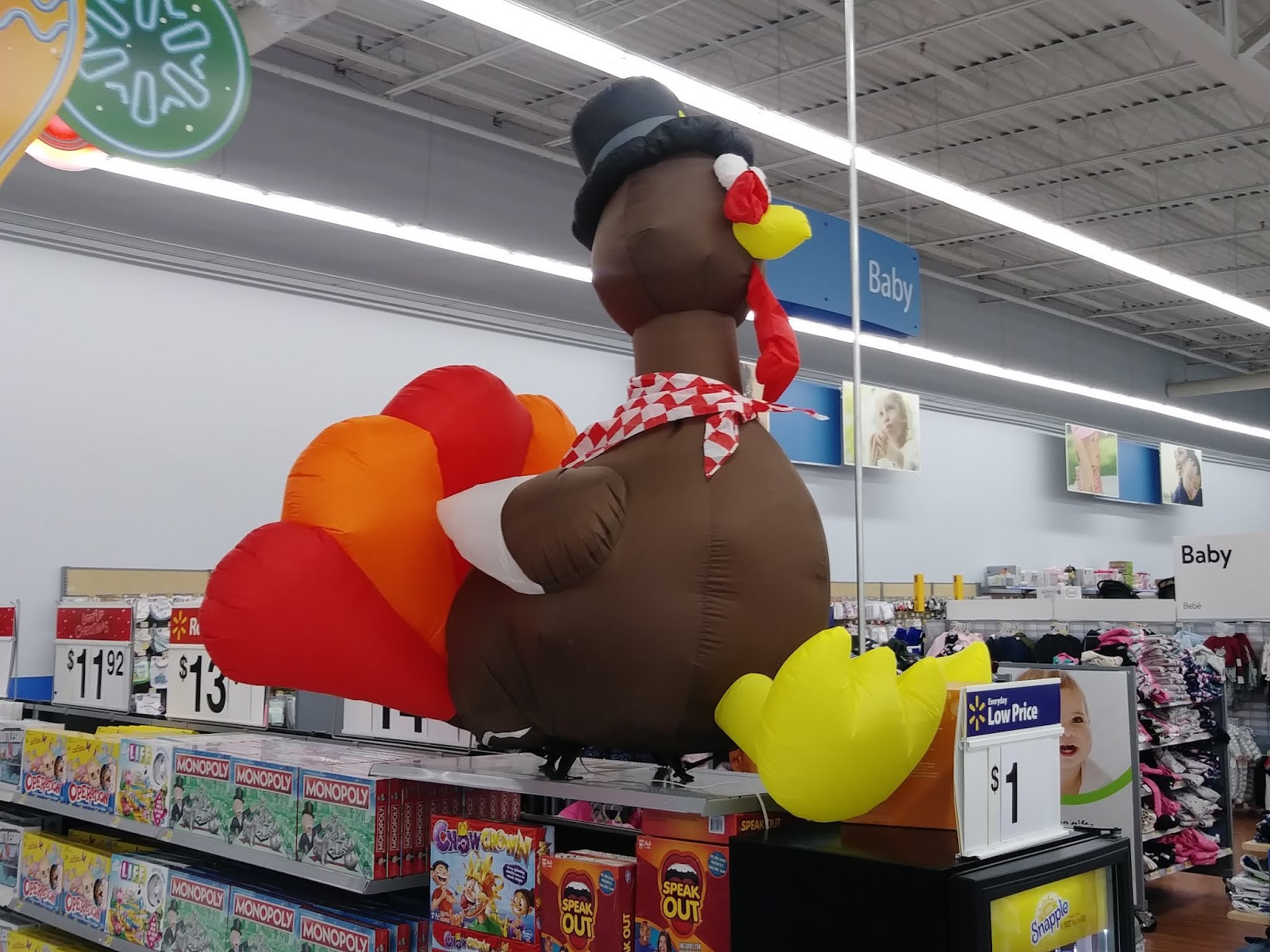
Showing posts with label Thanksgiving. Show all posts

Tuesday, November 19, 2019

Take Plymouth National For Thanksgiving


I am not aware of a holiday more tied to a small town than Thanksgiving is to Plymouth. Only Bethlehem rivals it. Without Plymouth, the whole script is gone.

So why shouldn't Plymouth's Thanksgiving celebrations be televised nationally?

This question is more pressing when you consider that the two things most heavily associated with Thanksgiving beyond the giving-thanks dinners are parades and football.

Plymouth has both of those. They just get nothing beyond local exposure.

How can (and should) we change that?


One obstacle involves the parade and the football game being held on different days. Another is that people have dinners to prepare, travel to or both.

Why take on those difficulties? Let's imagine a best case scenario.

Thanksgiving day starts with a parade, televised nationally. It is routed so that it goes directly past Plymouth Rock and directly to Plymouth North High School. The parade itself will finish with a lap around the football field.

From there, Plymouth North and Plymouth South will play their Thanksgiving game. This game, like the parade, will also be televised nationally.

This brings prestige onto Plymouth. It brings tourists to Plymouth. While switching to this format may have costs, the event will eventually be a yearly cash cow. The broadcast would essentially be a Plymouth infomercial.

ESPN could televise both. There are several ESPNs who could handle this. They could show the parade on delay during halftime of the football game if time is an issue.

The parade could also be televised by a different network if ESPN wishes to stick to sports.


Plymouth's parade would be more Americana than the one in New friggin' York. The New York parade is merely a marketing plan by Macy's. The department store runs that parade to their store, to sort of kick off Christmas shopping season.

Ours, while also seeking a dollar, would be more true to the spirit of the actual Thanksgiving holiday... and remember, no city or town has a greater claim to Thanksgiving than Plymouth.

Plymouth's parade will be more small-time than Macy's. Plymouth will have no Led Zeppelin I sized Snoopy blimps. Mariah Carey or Katy Perry won't be singing at Plymouth Rock (although it couldn't hurt to ask them). We'd have to make up for this with small town charm.

The smaller parade will also be easier to televise, fitting rather snugly into a football halftime slot.


ESPN gets handed a ready-made tradition to broadcast, so America that apple pie would be reduced to a bit part. They could up the Americana with brief vignettes featuring Plymouth Rock, Plimoth Plantation, the Mayflower II and the Wampanoag people.

Plymouth gets exposure, revenue and town spirit.  They stake an incontrovertible claim to a holiday that they already should own.

Remember... without Plymouth, the Thanksgiving we know and love would be wildly different, if it even existed at all. When you think of Thanksgiving, you think of Plymouth. The rest of the world needs to recognize.

Someone should already be working on this.


Sunday, November 17, 2019

Who Invented The Thanksgiving Sandwich?


Cape Cod's Claim To The Day After Thanksgiving Sandwich
I wrote about our local wild turkey population recently. I then spent considerable time and effort trying to find out who invented the Gobbler.
The Gobbler, as you most likely know, is a regional name for a Turkey/Cranberry/Stuffing sandwich. Depending on where you're getting one, it may have a variety of ingredients. It may also have a variety of names, such as the Mayflower Sandwich, the Thanksgiving Sandwich, the Day After Thanksgiving Sandwich, the John Alden, the Myles Standish, the Squanto, the Samoset, the Turkey Bomb, the TCS, the Black Friday Special, the Pilgrim Sandwich, the November Surprise, the Governor Bradford and God knows what others.
It is one of America's most popular sandwiches, and on the day after Thanksgiving, it is THE most popular sandwich. While the Fluffernutter is the Boston's signature sandwich, the Gobbler is probably the signature sandwich of Plymouth County. I'd actually use Bourne as the cutoff point from which the lobster roll asserts her sandwich authority over the lands across the Canal.
With the advent of modern appliances, the immediate post-Edison version of the Gobbler was probably invented on the East Coast by whoever got hungry first before the plates were washed. Just like the Earl of Sandwich centuries before, this god-among-us figured out that thick bread makes for a pretty good plate. Before someone invented the fridge, leftover turkey most likely went into a slow-simmering soup.
We "know" that the Earl of Sandwich invented the sandwich in the 18th Century so he could eat while he gambled, and never-you-mind better historical claims by Europeans and their trencher/open-faced sandwiches, the ancient Jews and their matze Passover culinary explorations, or the Aztecs and their corn tortillas (often filled with turkey to make history's first turkey sandwich, but the Aztecs were nowhere near the cranberries needed for the Gobbler). None of their stories involve needing a hand free to gamble, so I'm going with Earl. If you are patient, we'll tie the Gobbler back to him.


Turkeys, native to America, were introduced to Europe in the 1500s through Turkish markets via the Spanish. Stuffed turkey was popular in Europe by the 1600s, and bread was most likely on those same tables. Those are 3 of the 4 main ingredients in the Gobbler, but the cranberry sauce was a century away.
In spite of the fact that turkey-at-Plimoth was common knowledge, it didn't become the Thanksgiving anchorman in America until about 1800. If you need an English visual, remember that the Cratchit family from A Christmas Carol (1843) was going to eat a goose before Scrooge intervened with a holiday turkey and some Obamacare. Turkey was a popular holiday meal in America long before Abe Lincoln nationalized the holiday, and long before even that in Europe.
I struck out on finding the actual inventor of the Gobbler, and had difficulty even finding speculation on the matter. There were no claims made on it. Since my research yielded nothing, I am forced to rely on my own creativity and logic.

The Pilgrims look like a good bet, as they had turkey, stuffing (stuffing dates back to the Romans, at least), and- most importantly- access to cranberries. Not only access, but they also were essentially getting the first (white people) crack at them. 
They were slow to catch on, as the nation/world's first large cranberry cultivation system was established by American Revolution vet Captain Henry Hall in Dennis in 1816, but we were shipping them to Europe by 1820.
The Pilgrims were neither wealthy nor frivolous, and sugar is needed in large amounts to make cranberry sauce as we know it. 
The Ps might have used lightly sugared cranberries, as straight cranberry is too tart to eat enjoyably- even for someone who considered some nice salted mutton to be good eatin'. Such a thing as sugared berries would have almost certainly been a dessert.
All the necessary ingredients for the Gobbler were in place in some form at the first Thanksgiving. William Bradford's account put turkey, cranberries, and cornbread on the table. Stuffed turkey was a traditional holiday meal in the Europe they had just left. That almost assuredly puts stuffing (of a cornbread variety) on that table as well.
There were creative minds from a variety of cultures sitting at that table, and remember that some of those minds were quite remarkable. In that context, you'd almost be amazed if someone there didn't invent the Gobbler. It'd be like watching Tesla get transported to 2014 and fail to figure out how to turn on the TV.
While that doesn't solve the mystery, it gives us a basis for more speculation. Since we've narrowed it down to the table the Gobbler most likely was first enjoyed at, we have to- for the sake of everybody who got up on the 4th Friday in November and went straight for the hair of the dog- make an effort to name the genius in 1621 who put two and two together and somehow made something tastier than four.
I'll start by looking at the Wampanoags.

They shouldn't be the less obvious choice. They could make their own forms of bread, they had turkey running around, and probably had about 5,000-30,000 years of experience with cranberries before the Europeans arrived.
You can go to Plimoth Plantation tomorrow and see the Wampanoag historical role-players cooking cranberry cornbread (Nasaump) that looks a lot like squishy-style bird stuffing. They even made a cranberry boiled bread, a cranberry syrup called Sassamanesh, and had numerous turkey recipes. They were working with all of the ingredients for centuries.
Any argument against the Wampanoags inventing some form of the Gobbler pretty much hinges on nobody in 5-30000 years putting some meat, cranberries (cranberries were used when making pemmican, making the Wampanoag Gobbler even that much more likely), and some form of stuffing between two pieces of bread.
The reader will note that we mentioned ancient Native Americans using tortillas. Ideas move through different tribes just like they do with different Europeans, and the idea of wrapping food in bread could have quite possibly diffused from Tortilla Land to the Cranberry-Turkey Land. Once that happens, you just need one Algonquin genius.
You can run the Wampanoag-exclusive Gobbler theory right up to the first Thanksgiving. The Wampanoags introduced cranberries to starving English settlers, and they are almost certainly among the berries (although most likely in food prepared by the Wampanoags) described by Bradford in his account of the first Thanksgiving. 

I'd even pick a Wampanoag (not used to knives and forks and so forth) to be more likely to create a Gobbler when presented with turkey, cranberries, stuffing and bread than some scared and rigid European who was used to European table manners.
I'd even throw in the chance that some Pilgrim woman fashioned some sort of bread-cup and filled it with the Gobbler ingredients for a departing Wampanoag, inventing the Gobbler while concurrently serving America's first take-out meal.
The other option at that table to invent the Gobbler relies more on mysticism and legend... which you'd think would favor the Wampanoags, but they actually have too good of a grasp on Common Sense in this discussion to latch onto the abstract stuff. It favors Bourne.
I can make this simple. Even the most ardent supporter of the Wampanoag Gobbler theory would have to admit that the Great Spirit usually gives you a sign. While Plimoth had the more famous Wampanoag interaction and is the most likely Genesis Spot for a white man's Gobbler, the majority of trade between colonists and natives and the New Netherlands in the time following the feast went down at the Aptucxet Trading Post, in Bourne. There was a great deal of cultural and culinary diffusion going on in Bourne until around or before the Great Colonial Hurricane blew America's First Store flat in 1635.
If Plimoth was the Gobbler's Bethlehem, Bourne may have indeed been the Gobbler's Nazareth. From there, much like Jesus, it took over half the world. The ethnicity of the first Gobbler's creator matters less to me than the chance that someone from Bourne may have invented (or at least first ingested) one of America's greatest sandwiches.
The only problem here is that Bourne wasn't Bourne until 1884, when it broke away from the town it used to belong to, the town named for a British aristocrat, the town that wins the Pilgrims and Bourne the right to call the Gobbler their own, the town that grants my theory the approval of the Great Spirit, and the town that ends this discussion.
The name of that town?
"Sandwich. "


Monday, December 3, 2018

Duxbury/Marshfield Thanksgiving Leftovers


Duxbury and Marshfield square off in the 2018 Thanksgiving game. Better late than never, we have some pictures and videos.

"It's so cold in the D..."

As you can see, our photographers bundle up like half-assed Eskimos, including this big turkey taking a Siberian Selfie.

We're cheating a bit here, she's at the Plymouth game.


Back to Duxbury....


The end zones got a lot of use in a game where you could have cashed in taking the Over on a 63 point betting line.

Throw it up high...


Attendance was lowered some by the Finland-like frostiness.

We tried to get action photos, but they kept running plays towards the leeward side of the field. We were on the windward side.

The Duxbury Dog was representing hard.


The low turnout was a bit disappointing, as many folks use the Thanksgiving game as a de facto class reunion.


"Kickin' like Cato"


If you're still in the stands when you can't feel your feet/you're forever a part of the Hardcore Elite.


Duxbury ran a lot, but we patiently waited for them to chuck one.


Vegas went for two the only time we had a camera aimed at them, so we'll pay ST respect by showing the punter some love.


Green Dragon Gathering

A second gathering, near the Heat Howitzer


"Good morning or good night/you will not hear me say/but I look at the scoreboard/smile to myself/because I know we had a Good Day"


Sunday, December 2, 2018

Plymouth's Thanksgiving Game Should Be Nationally Televised


Plymouth is the very real base of Thanksgiving. Ignore anyone claiming that the first Thanksgiving was in Virginia, which is what they call inconvenient truth

They were the first. We were the first that mattered.

Plymouth is as/more important to Thanksgiving than turkey, pumpkin pie or even football. Football is where we're headed, after this video.


Thanksgiving football has her roots in Massachusetts, with some rivalries going back to the 1800s. We have rivalries that were three decades old by the time someone said, "Arizona should be a state."

A lot has happened since that fateful day in Arizona, such as the development of TV and especially ESPN. ESPN does 24/7/365 sports coverage, and one of those 365 is Thanksgiving.

We have an all-sports TV network which broadcasts on Thanksgiving, a state with the oldest rivalries in the biggest TV sport and the town where Thanksgiving truly began. That town even has two high schools, and they play each other on Thanksgiving.


I should add that there seem to be several ESPNs, as well as a gang of other networks (FOX, NBC, etc...) with all-sports broadcasting.

There is definitely room for the national broadcast of the Plymouth Thanksgiving game.

There are better quality high school football games played in Texas and Florida. Plymouth doesn't produce NFL stars, their stadiums have a cookie-cutter look to them and the best teams in the area are from Duxbury, Scituate and Cohasset.


All of these problems can be solved, and some come pre-solved. There isn't a person alive who would free-associate "Thanksgiving" and "Denton, Texas." Aside from some stubborn Chamber of Commerce people in Virginia, there most likely isn't a person alive who wouldn't free-associate Plymouth with Thanksgiving.

The lower quality football problem would be offset by the parity between Plymouth North and Plymouth South. If the game is compelling, a viewer could ignore the fact that a Florida team would beat both Plymouth teams combined by 75 points.

Shoot, I've been covering sports for 20 years, and have been a fan since I was a toddler. Once you remove the high stakes aspect of a Super Bowl or a World Cup final, the most compelling game that I ever saw- in terms of drama, excitement, near misses and effort- was a 2 OT Duxbury High School girls soccer game in 1986.

Ok, maybe Hagler/Hearns has it beat, but you can see where I'm headed.


Mix all of this together, and it makes sense to televise the Plymouth Thanksgiving game nationally.

Thanksgiving doesn't really have TV power, other than the Macy's parade (which is really a Christmas parade, with the Object being the transport of Santa to Macy's) and that Charlie Brown special where Snoopy serves everyone toast and popcorn. There is no Rudolph or Easter Bunny dominating the telly, especially at 10 in the morning.

If they televise the Plymouth game, and if it became a traditional broadcast event over time, they'd knock off at least some of that problem.


You'd have several traditions mashed into one event. Small town football on Thanksgiving morning, waged in the town that started it all.

There are flaws, but they could be corrected with a bit of imagination. 

The stadium would need to be upgraded, perhaps to resemble the Mayflower. That would be a fine way to spend the ESPN money. I would argue for building a new stadium on the Plimoth Plantation grounds.

The bands would need to up their game, although I would stop short of performing Alice's Restaurant. 

The schools would need mascot rebranding, with one being the Pilgrims and the other being the most PC version of "Indians" they could come up with.

The cheerleaders should be dressed like this.

Every time they cut to or back from a commercial, the viewer could be treated to a quick video of the local autumnal visuals, like Plymouth Rock, the Mayflower, a cranberry bog, fall foliage, Plimoth Plantation, wild turkeys, Clark's Island, a local farm harvest, the Plymouth Thanksgiving parade or a Wampanoag sunrise celebration.

Boom! We have us a 10 AM Turkey day party, and a new American tradition. If the right people were running Plymouth and ESPN, we'd already be 20 years into this.


Monday, November 19, 2018

Thanksgiving Primer: Turkeys

It's time to talk Turkey!

Turkeys are native to the Americas. No less an authority than Benjamin Franklin advocated for the turkey to be our national symbol, a role filled instead by the eagle.


Turkeys were used by Native Americans for food. Spanish explorers noted that the Aztecs made tamales with turkey, which means that the Aztecs invented the Turkey Sandwich.

Threatening a turkey was invented in 2018, by the staff of Cranberry County Magazine (see below)...


Turkeys are named after the nation of Turkey, just in case you thought it was the other way around. They were brought to Europe by Spanish, English and French explorers, and became popular there. One breed of turkeys in England can trace their stock back to the first Earl of Orford, who brought back a quantity from the colonies.

The nation-of-Turkey part relates to the commercial trade in the birds. Spain would sell turkeys into Mediterranean markets, with many of them being sold to European traders afterwards by Ottoman merchants. People began to call them Turkish fowl and so forth, and then just Turkeys.

Shakespeare used the term in 1601, and the casual use of it by Billy Shakes implies that the term was in common use.


Turkeys are both wild and domestic in the Americas. Adult males are called Toms or Gobblers, adult females are called Hens, and juvenile turkeys are called Jakes. Males are larger and more colorful than females. Turkeys have over 5000 feathers.

Turkeys weigh 11-24 pounds generally, with 17 pounds as the average weight. The record weight is 37 pounds. They are among the largest native birds in North America, surpassed only by Condors, Cranes, Pelicans and Swans.

Turkeys prefer forests, as they roost in trees to avoid predators. They are active in daylight, as they have horrible night vision.

They are excellent and agile flyers, contrary to what you may have seen on WKRP in Cincinnati.

 Much like the Wright Brothers, they tend to fly low and rarely fly more than a quarter mile. Wild turkeys do not migrate.

They are very tasty birds. This hurt them during colonial times, with the species being eradicated in some areas. They went from tens of millions to 1.3 million in the 1980s. Restoration efforts have the number up to 7 million now, and they are a common sight in Massachusetts.

They were rare enough to be a luxury meal by the 1800s. The Cratchit family was going to eat a goose for Christmas before Scrooge sprang for the turkey.

Turkeys have a strict social code which they sometimes work humans into. A submissive Turkey may follow a human, while a flock leader may attack humans. It is advised by some to scare turkeys if they start acting aggressive, and even tree huggers advance the concept of beating one down if you absolutely have to.

Turkeys on the Thanksgiving table are domestic, and not wild turkeys. There is often Wild Turkey on my family's dinner table... but we are of Irish descent, and things just sort of work out that way at times.

Our models today are from Plymouth, Onset and Cape Cod Community College in Hyannis.